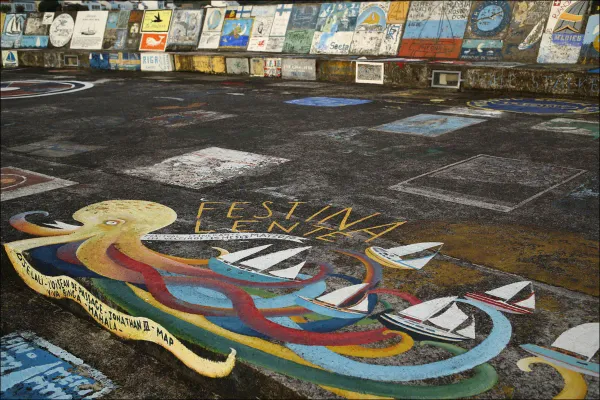
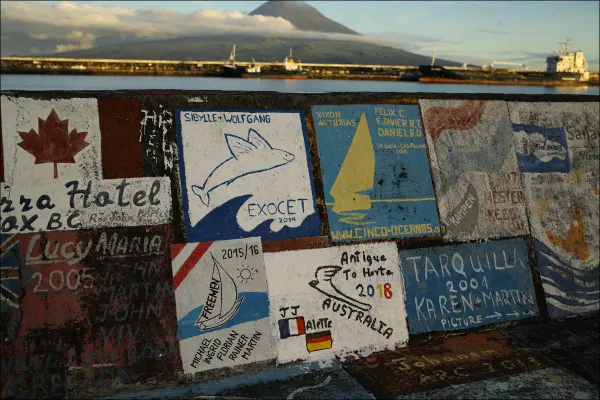
On the concrete embankment of Horta marina — thousands of drawings. Yachts, flags, names, dates, coordinates. In paint, marker, chalk. One on top of another, layer by layer, over decades. Each one an autograph from a sailor who crossed the Atlantic. Each one a promise: “I made it. I’m alive. The ocean let me go.”
There’s a superstition: if you cross the Atlantic and don’t leave a drawing on the Horta embankment — the ocean will punish you on the return journey. No one remembers when it started. But today every square centimetre of concrete is covered in signatures — a colourful carpet of yacht names, countries, dates and drawings, ranging from professional graffiti to children’s scrawls. Some have faded from sun and salt. Some are fresh, still smelling of paint.
Faial is an island in the middle of the Atlantic. Literally — the middle. 1,500 kilometres from Europe, 3,500 from America. Neither here nor there. A waypoint between worlds, which for centuries served a single purpose: resupply, repair the ship, rest — and move on.
In the 18th and 19th centuries, American whaling ships called here — from Nantucket, from New Bedford, from Sag Harbor. Sperm whale oil — spermaceti — burned brighter and cleaner than any candle, and the world wanted light. Many Azoreans signed on to these ships — young, hungry, ready to risk their lives for a wage. Hunting sperm whales — with a harpoon, from an open longboat, in a stormy Atlantic Ocean, against an animal weighing 50 tonnes — was the most dangerous work on the planet.
Herman Melville, who wrote Moby-Dick, visited the Azores. Azorean whalers are the prototypes of some of his characters: harpooners, helmsmen, sailors. Men who went to America to kill whales — and came back (if they came back) with money and scars.
The last sperm whale in the Azores was killed in 1987. Since then — only observation. But — and this is the key point — the watchers on the cliffs, vigías, scanning for spouts through binoculars, are the same people. Descendants of whalers. Sons and grandsons of those who shouted “Baleia!” and ran to the harpoon. Now they shout “Baleia!” — and run to the radio. The same eyes. The same cliffs. A different purpose.
Whaling in the Azores continued until 1987 — longer than almost anywhere else in the world. The last Azorean whaler — a man who hunted sperm whales with a harpoon from a wooden longboat in the 20th century — is still alive. The whaling museum on Pico Island holds harpoons, longboats and scrimshaw — engravings on sperm whale teeth and bones, made by whalers during long months at sea. Miniature works of art, created by men who killed whales.
Today those same sperm whales are not prey but the main attraction. The former whaler lookout towers — stone structures on the cliffs from which a spotter would search for spouts — are now used by whale-watching companies. Instead of a cry of “Whale!” and the launching of longboats — a call to the captain: “Sperm whales to the south, three miles.” And a boat full of visitors races to where a grey back breaks the surface.
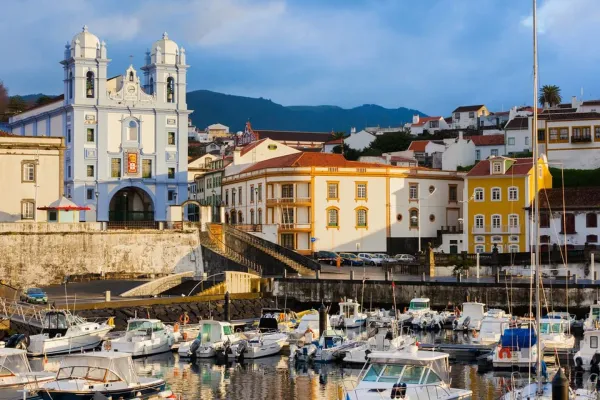
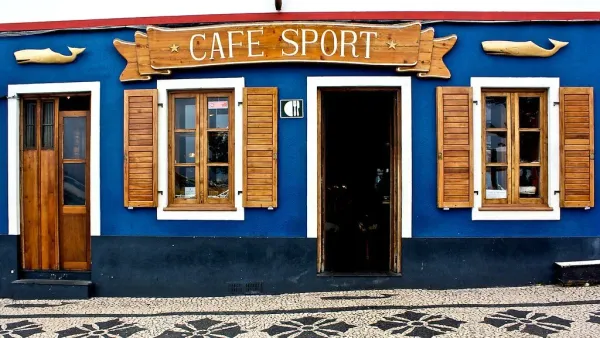
Peter Café Sport is a legend of Horta. Founded in the 1920s, this café became the unofficial headquarters for everyone crossing the Atlantic. Sailors, regatta crews, solo voyagers — everyone stops at Peter’s. The walls are hung with burgees from yacht clubs around the world. On the second floor — a scrimshaw museum. Behind the bar — the signature gin and tonic (said to be the best in the Atlantic). Friendships are formed here, expeditions are born, and stories are told that are hard to believe — but all of them are true.
Faial is the “island of blue hydrangeas.” They were brought from Asia centuries ago — ornamental shrubs for gardens. But on Faial, what happens to all living things in the Azores happened to them: they took hold. Hydrangeas conquered the island. Enormous — two-metre — bushes grow along every road, every fence, every stone wall. Blue, violet, lavender — the colour depends on soil acidity, and on volcanic Faial the soil is acidic, so the hydrangeas are vivid blue. As you drive along the road, an endless blue ribbon of flowers accompanies you against a backdrop of green hills and grey-blue ocean. Three colours: blue, green, grey. The palette of Faial.
The island is small — 173 square kilometres, 15,000 inhabitants. Everyone knows everyone. The pace of life is island life: no one is in a hurry, cafés open whenever they please, the bus arrives approximately on time. “Approximately” is the key word in the Azores. Nothing happens on schedule. Everything happens — when it’s supposed to.
And then — the Capelinhos volcano. In 1957 the ocean floor off the western shore of Faial exploded. The eruption lasted 13 months. Lava, ash and rock buried the lighthouse — it “sank” into volcanic deposits like a toy in a sandpit. The island grew by 2.4 square kilometres — new land, created in a year. Today the Capelinhos landscape is lunar: grey ash, solidified lava, dead earth on which the first plants are appearing, slowly, very slowly.
Nearby stands an interactive museum of volcanic activity, built inside the volcanic landscape itself. Screens, models, simulations — but the main exhibit is outside the window: a lunar desert of grey ash in which the first mosses and lichens are, slowly, very slowly, pushing through. Life is returning. Seventy years is nothing to a volcano. But already something to a moss.
And the realisation: the Azores are not frozen islands. They are alive. They are growing. Right now, beneath your feet, magma flows through fissures in the earth’s crust. The last submarine eruption near the Azores was in 1998. Not a thousand years ago — 28 years ago. The islands are not a backdrop. They are a process.
And in the waters around these islands — 23 species of whales. More than anywhere else in the Atlantic. And among them — the largest creature that has ever lived on Earth.