What happens to a person when nothing familiar remains?
No roads. No buildings. No schedules. No connectivity. No notifications. No news. No traffic. No deadlines. No calls to return. Only ice that is hundreds of thousands of years old, water older than any civilization, and a sky that never goes fully dark.
People who have been to Antarctica describe the same feeling. They name it differently — “reset,” “reboot,” “silence within” — but the meaning is the same. Somewhere around the third or fourth day, when the Drake Passage is behind you and the ship enters Antarctic waters, something changes. Not outside — inside.
First, the inner monologue goes quiet. That endless stream of thoughts — “need to reply to that email,” “don’t forget to call back,” “what’s happening with the project,” “how is mom doing” — the one we don’t even notice because we’ve grown so used to it. It simply stops. Not because you’re meditating. Not because you’re trying. But because there is nothing around you to trigger it. Not a single familiar cue. The brain, stripped of the signals it has been trained to respond to, simply falls silent.
Then comes the scale. And scale is what changes everything.
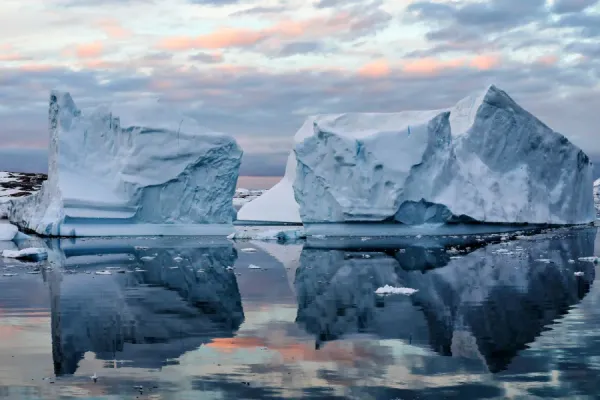
The iceberg the ship passes is sixty meters tall — the height of a twenty-story building. But that is only what rises above the water. Below the surface there is seven to eight times more. The iceberg that looks the size of a city block is actually the size of a small town. It broke off from a glacier that had been forming for tens of thousands of years, and now it slowly drifts north, melting, shifting shape, going from fortress to arch, from arch to needle, from needle to water. Every iceberg is a one-of-a-kind work of art. Its form exists only now, only in this moment. In a year it will be gone. In ten years the water it was made of will be part of the Atlantic.
The glacier sliding into Marguerite Bay began forming 15,000 years ago — when people were still painting bison on cave walls at Lascaux. The oldest layers of Antarctic ice are 2.7 million years old. When that ice froze, Homo sapiens did not yet exist on Earth.
The mountains on the horizon are unnamed. They have no names because no one has ever set foot on them. No one has climbed those peaks, planted a flag, or given them a title. Here there are more unnamed mountains than named ones. This is the only place on the planet where geography is still unfinished. Where you can discover a bay that appears on no map.
And you stand on the deck, gripping the railing, looking at that glacier fifteen thousand years old, at those mountains without names, at water that was snow before the dawn of civilization — and suddenly, not with your mind but with something deeper, something that has no word, you understand how small you are.
And it does not frighten you. It sets you free. Because if you are small — then your problems are small too. And your fears. And your grievances. And your deadlines. All of that is noise. And here there is silence. And in that silence, for the first time in a long while, you hear yourself.
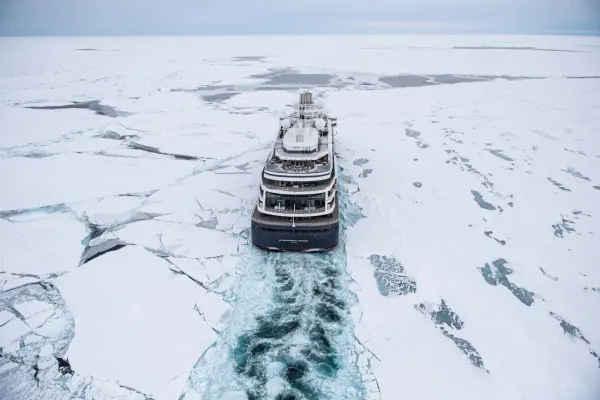
14 days. A route that retraces Charcot’s path. Now on a ship that bears his name.
Ushuaia — “the End of the World,” a city nestled between mountains and sea, where the Andes draw their last breath before sinking into the ocean. This is where everything begins.
The Drake Passage — two days of crossing that must be endured to earn what comes next. Albatrosses, with wingspans of three and a half meters, appear on the second day — heralds of another world.
The Antarctic Circle — 66°33’ south latitude. Champagne on deck. A polar explorer’s passport. And the first iceberg — real, not from a picture — blue like nothing else on earth, streaked with white and dark, resembling a cathedral and a mountain range at the same time.
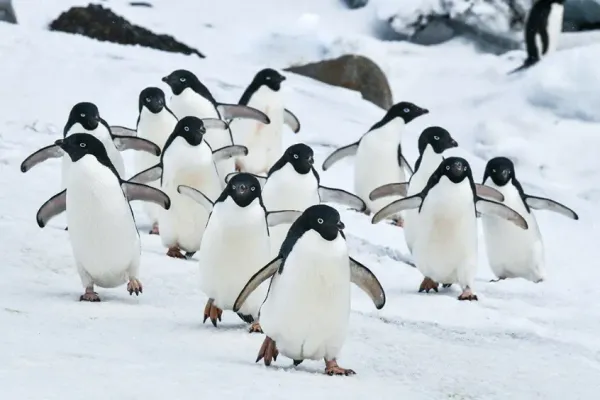
Detaille Island — an abandoned British station, penguins that approach you on their own. The Gullet — a narrow corridor between walls of ice, first navigated by Charcot in 1909. This is also where Philippe Cousteau — son of Jacques-Yves Cousteau — made the first underwater footage of Antarctica in 1972–73.
Charcot Island — the very one he discovered in 1910 and named after his father. 630 square kilometers, completely covered in ice. One of the least visited islands on the planet — almost no one has ever landed on its shores.
The Bellingshausen Sea — named after the Russian admiral who discovered Antarctica. Here, near the coastal ice, live colonies of emperor penguins — the ones that incubate eggs at minus sixty, standing in icy wind for two months without food.
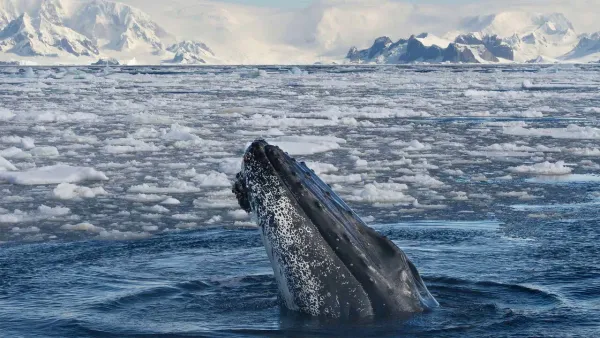
Marguerite Bay — named by Charcot after his wife. Icebergs in water the color of dark indigo. Humpback whales sending up fountains thirty meters from the Zodiac. Leopard seals — spotted, fast, with mouths full of teeth — lounging lazily on ice floes and watching you as you pass.

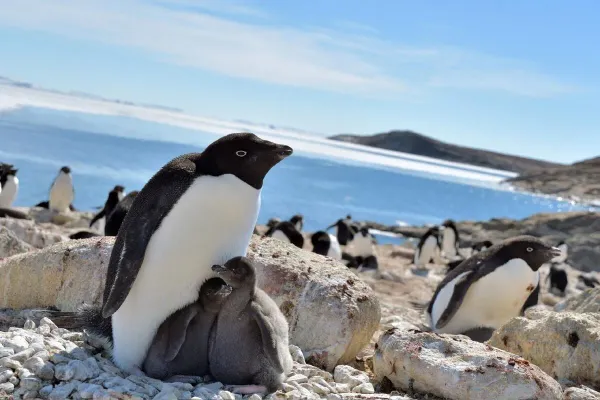
Pourquoi Pas Island — 28 kilometers long, named after Charcot’s ship. The same ship that would break apart on the reefs of Iceland 26 years later. Narrow fjords, snow-covered mountains, Adélie penguins on rocky shores. A Zodiac landing — and the feeling that you have stepped onto another planet.
The Lemaire Channel — “Kodak Gap,” as photographers call it, because it is impossible not to shoot here. A narrow passage just 1,600 meters wide between the sheer cliffs of the peninsula and Booth Island. Glaciers slide directly into the water on both sides. The ship passes so close to the walls that you feel you could reach out and touch the ice. The water is a mirror. The mountains are a reflection. The silence is so complete that you hear a piece of ice the size of a car break away from the glacier, fall into the water with a muffled boom, and send a wave slowly rolling toward the hull of the ship.
Charcot first navigated this channel in 1909. He wrote in his journal: “A spectacle so beautiful that it is impossible to describe in words — only to be silent and look.” Over a hundred years later, nothing has changed. The people on the deck of Le Commandant Charcot do the same: they are silent and they look.
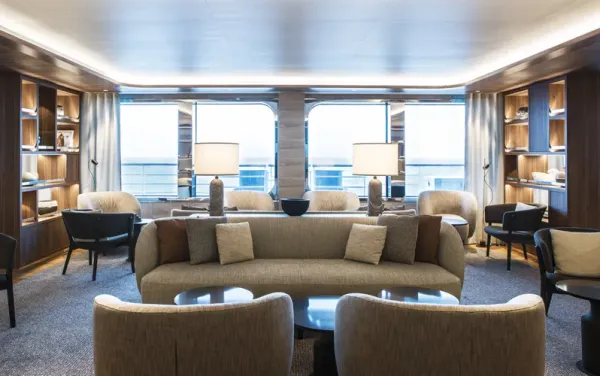
And every evening — a return to the ship. Wet jackets on the hook. Rubber boots into the drying rack. A hot shower — after three hours on a Zodiac among icebergs, that feeling is worth all the money in the world. Then dinner: stone, wood, leather, soft light, a chef who turns Patagonian lamb into a work of art. Wine from the cellar, chosen by the sommelier for every course.
After dinner — a lecture. Not a dull academic presentation with charts, but a living account from a marine biologist, ornithologist, or glaciologist about what you saw today. Why that iceberg is blue — because ice under pressure absorbs the red spectrum of light. Why a whale leaps — perhaps to shed parasites, or perhaps simply from an excess of energy. Why penguins build nests from stones — because in Antarctica there is not a single stick, not a blade of grass, not a leaf. Stone is the only building material.
And outside the panoramic cabin window — a wall of ice lit by the sun, which skims along the horizon and does not set. Antarctic summer: the sun barely goes down for nearly a full day. You fall asleep at three in the morning — and it is still light outside. The curtains are thick, but you do not draw them. Because why would you.
Charcot gave these waters his life. On a wooden ship, without heating, without communication, without charts. Without GPS, without a satellite phone, without a weather radar. Only a compass, a sextant, and the stars — when they were visible through the clouds. He came here again and again because he believed: there are places on Earth worth any price. Places where a person ceases to be the center of the universe — and because of that, paradoxically, becomes larger.
Le Commandant Charcot — the ship that bears his name — travels the same route. Past the island he discovered. Through the bay he named after his wife. To the shores he was the first to put on a map.
The difference is that you will return.
17 people gave this journey 5 stars. But stars are a strange measure for a place where there is not a single lamp. Where the only light is the sun, skimming the horizon and never setting. Where scale is measured in millions of years, not meters. Where silence is not the absence of sound, but the presence of something greater.
People who have been to Antarctica say the same thing. Not right away — a day later, a week later, when they have returned home, when they are stuck in traffic again, or in a meeting, or in line for coffee. They say: “I cannot explain it. But I became different. Something changed. I don’t know what exactly. But it won’t go back.”
Perhaps Charcot felt the same. Perhaps that is why he returned to polar waters every year for forty years. Perhaps that is why he could not stop. Perhaps that is why — on that night, off the coast of Iceland — he did not take off his boots.
Because there are things worth living for. And there are places worth going to.
February 27 — March 12, 2027. In the wake of Charcot. On the ship that bears his name.