An Adélie penguin walked up to within half a meter and stared straight into the lens. It stood there. Tilted its head. Blinked. Took another step. Then turned around and waddled off — unhurried, rocking side to side, like a person wearing shoes that are just a little too tight.
This moment is one of the reasons people fly to the other end of the planet. Not for the photograph (though there will be a photograph). Not to tick a box on a bucket list (though that too). For a feeling that cannot be put into words, yet everyone who has been to Antarctica describes it the same way: “It came up to me on its own. It wasn’t afraid of me. At all.”
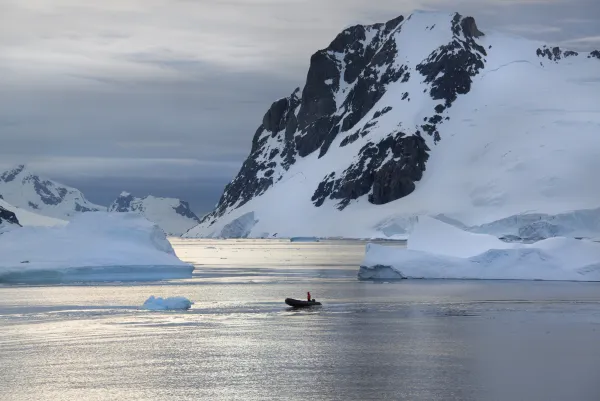
Antarctica is the only continent on Earth with no land predators. No bears, no wolves, no foxes, no cats. Not a single land mammal — none whatsoever. The largest land animal in Antarctica is a wingless midge measuring 6 millimeters long. Six millimeters. That is the apex of the food chain on land.
What does this mean for penguins? It means that over millions of years of evolution, they never developed an instinct to fear land creatures. There is nothing to run from. Nothing to hide from. When a penguin sees a human — a two-legged creature, five foot seven, in a red jacket — it feels not fear, but curiosity. To it, you are not a predator. You are a new object in a familiar landscape. Interesting, but not dangerous.
Young penguins are especially curious. They walk right up to you, peer into the camera, peck at your shoelaces with their beaks, sometimes try to nibble a shiny backpack buckle. Adult birds are calmer, but they don’t run either. They look at you with an expression that can only be interpreted one way: “Well, what exactly are you?”
IAATO (the International Association of Antarctica Tour Operators) rules prohibit approaching penguins within five meters. But the penguins haven’t read the rules. They come up on their own — and there’s nothing you can do about it except stand still and enjoy it.
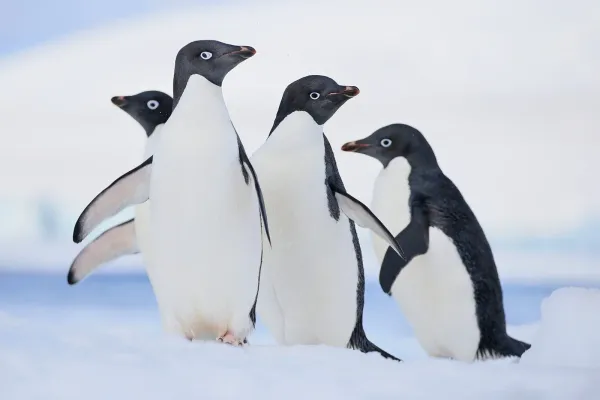
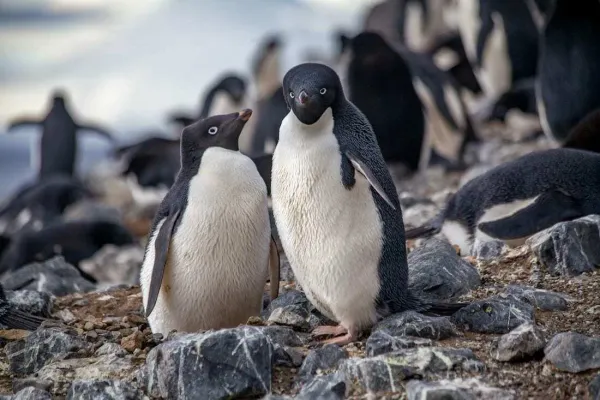
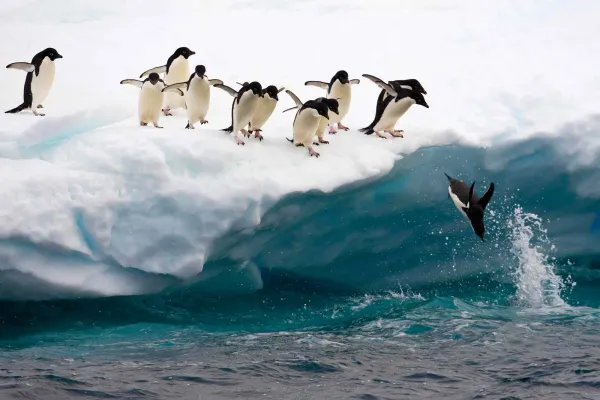
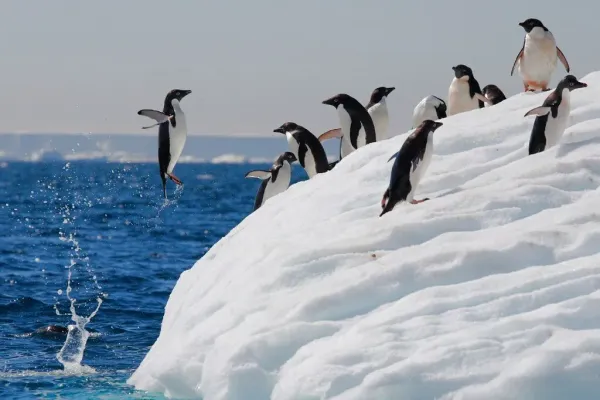
Several species of penguin inhabit the Antarctic waters along the Le Commandant Charcot route. Adélies are the most numerous: black and white, about 70 centimeters tall, endlessly busy. They’re always heading somewhere, carrying something in their beaks, squabbling with neighbors over pebbles for the nest, diving off ice cliffs and popping back out like corks from bottles. Watching an Adélie colony is like watching a comedy with a thousand actors, each playing their part with complete seriousness.
But the true kings of Antarctica are the emperor penguins.
A hundred and fifteen centimeters tall. Up to forty kilograms in weight. The largest penguins on the planet — and arguably the most enduring birds of any species alive. Emperor penguins are the only species that breeds during the Antarctic winter, at temperatures down to minus sixty degrees Celsius and hurricane winds up to 200 kilometers per hour.
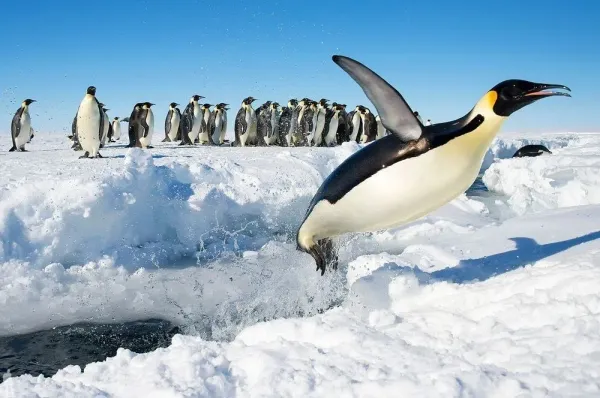
In winter, when the sea freezes and the sun stays below the horizon for months, male emperor penguins perform a feat that has no parallel in the animal world. The female lays an egg and heads for the sea — to feed. The male stays behind. He balances the egg on his feet, covers it with a fold of belly skin, and stands there for two months. Two months. Without eating. In the wind. At minus sixty.
To survive, thousands of males huddle together in a gigantic “huddle” — a dense mass where the birds press against each other, forming a living shield against the wind. The group rotates slowly: each penguin gradually moves from the frigid outer edge toward the warm center, then back to the edge. A democracy of survival: each one takes its turn bearing the wind, each one takes its turn warming in the center.
When spring comes and the females return — well-fed, with a stomach full of food for the chick — the males have lost up to 45% of their body weight. But the egg is intact. And the chick is alive.
Gentoo penguins are the third species you’ll encounter. They’re easy to spot: bright orange beaks and a white stripe across the top of the head, like a headband. Gentoos are the fastest swimmers among penguins: 36 kilometers per hour underwater. Faster than most motorboats in a harbor. They dive for krill and small fish, launching themselves onto shore like torpedoes — landing on their bellies and sliding across the ice, leaving a wet streak behind them.
Watching gentoos on shore is its own pleasure. They build nests from pebbles, and pebbles are the currency of the penguin world. A male brings a pebble to a female as a gift. She evaluates it. If the pebble is good — she accepts it. If not — she looks away. Penguins steal pebbles from each other, squabble, chase thieves, and stage dramas worthy of a soap opera. All of this with utterly serious faces, against a backdrop of glaciers and endless sky.
But the apex predators of Antarctica are not on land. They’re underwater.
Orcas are at the top of the Southern Ocean food chain. Three types of orca inhabit Antarctic waters, and each type is a distinct culture with its own hunting traditions passed down through generations.
Type A — the largest, up to 9 meters. They hunt whales and elephant seals. Type B — seal specialists. Their signature technique: a group of 5–7 orcas accelerates in sync, dives beneath the ice floe where a seal is resting, and generates a wave that washes the prey into the water. The coordination is military precision. The seal doesn’t even understand what’s happening until it’s in the water surrounded by five open mouths. Type C — the smallest, fish-eaters, hunting in the gaps between ice floes.
Orcas are among the few animals capable of killing a blue whale — the largest creature ever to have lived on Earth. They have language — a set of sounds unique to each family group, passed from mother to offspring. They have culture — hunting techniques that are not encoded in genes but transmitted through learning, generation to generation. A pod of orcas off the Antarctic Peninsula uses “wave washing” (sweeping a seal off an ice floe), while a pod in the Ross Sea does not. They speak different “dialects” and use different strategies — like people from different countries.
And yet they have never attacked a human being in the wild. Not a single confirmed case in the entire history of observation. An orca that can kill a whale looks at a diver in the water — and swims past. Why? No one knows for certain. One hypothesis: we’re too small and bony to be worth the effort. Another, more poetic one: they simply decided to leave us alone.
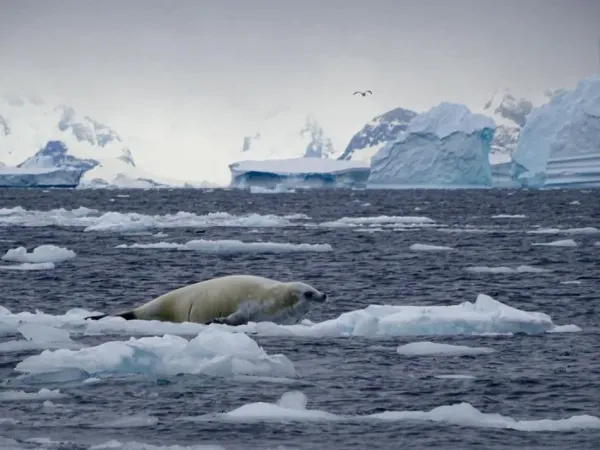
And then there are the creatures that seem impossible.
Icefish — family Channichthyidae. The only vertebrates on Earth without hemoglobin. Their blood is transparent. Literally: if you caught an icefish and cut its finger (if it had fingers), colorless liquid would flow from the wound. Their blood contains a natural antifreeze: glycoproteins that bind to ice crystals and prevent them from growing. This is how icefish live at water temperatures of minus 1.8 degrees Celsius — a temperature at which the blood of any other vertebrate would turn to ice.
The Weddell Sea, through which the Le Commandant Charcot route passes, is considered the clearest sea on the planet. Underwater visibility reaches 79 meters. By comparison: the Mediterranean offers 20–30 meters, the Black Sea 5–8 meters. The water is so clear it looks like liquid air.
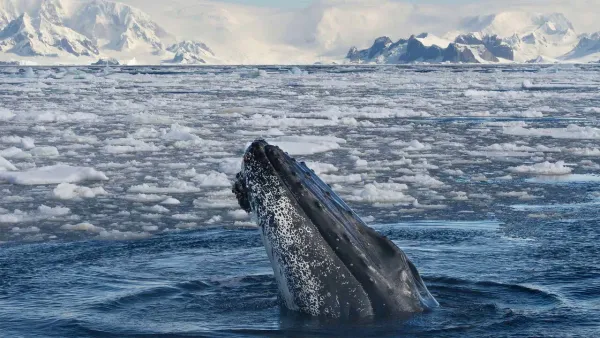
Humpback whales come here in summer — to feed on krill. Krill is a small crustacean, 5–6 centimeters long, resembling a teenage shrimp. An unremarkable creature. But krill is the foundation of the entire Antarctic ecosystem. Without it there would be no whales, no penguins, no seals. Its biomass in the Southern Ocean is estimated at 500 million tons — more than the combined weight of every human being on Earth. A single humpback whale consumes up to two tons of krill per day, filtering the water through baleen plates — flexible structures in the mouth that work like a massive sieve.
Humpback whales are among the most spectacular animals in Antarctica. They breach completely — 30 tons of living weight rising into the air and crashing back down in an explosion of spray. Why? Perhaps to knock parasites off their skin. Perhaps to communicate. Perhaps — and this is the explanation I like best — simply because they can.
Sperm whales dive even deeper — to 3,000 meters, into absolute darkness, where the pressure would crush a submarine. They hunt giant squid — creatures up to 13 meters long, with eyes the size of basketballs, that almost no one has ever seen alive. Everything we know about giant squid comes from the sucker scars on the skin of sperm whales. Circular marks, 5 centimeters in diameter. Evidence of battles that take place in pitch darkness, at a depth where no ray of light ever reaches.
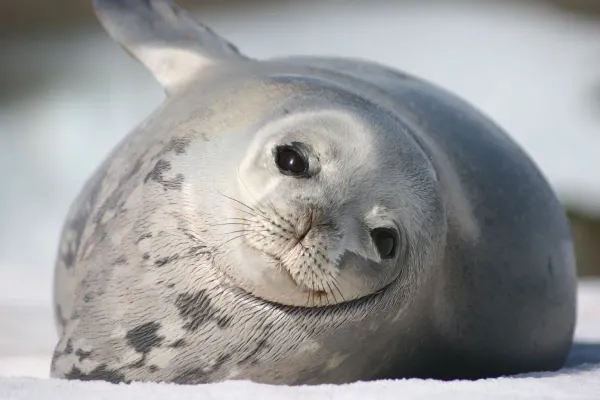
Transparent blood. A fish that doesn’t freeze. A penguin that isn’t afraid of people and stands in the wind for two months with an egg on its feet. An orca that hunts whales but doesn’t touch humans. A whale diving three kilometers into absolute darkness after a creature we can’t even photograph.
This is not a nature documentary. This is not computer graphics. This is what you will see — with your own eyes, from the ship’s deck and from a Zodiac — in an expedition 14 days from Antarctica.
But what does a place do to a person where the rules of the familiar world no longer apply? Where there are no roads, no schedules, no signal — only ice that is hundreds of thousands of years old, and a silence you have never heard before?