6 centimeters of steel. Enough to withstand the pressure of Arctic ice. And enough to bury the story of wooden ships forever.
When the Pourquoi Pas? was wrecked on the reefs of Iceland in 1936, the era of wooden polar vessels came to an end. Oak, elm, hemp, canvas, coal-fired steam engines — all of it relegated to the past. Eighty-five years later, the ship bearing Charcot’s name shares nothing with its predecessor. Except one thing: it goes to the same place. Into the ice.
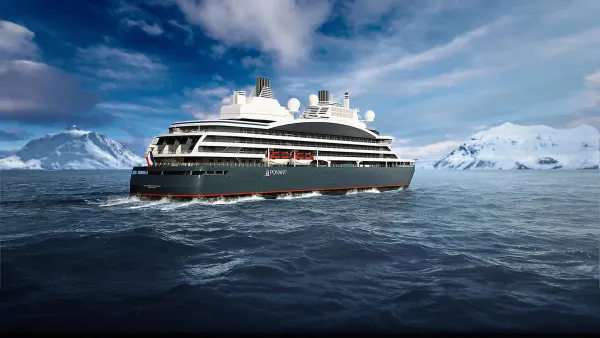
Le Commandant Charcot. 150 meters in length. 28 meters in beam. 31,757 tons of displacement. Numbers that represent an engineering revolution.
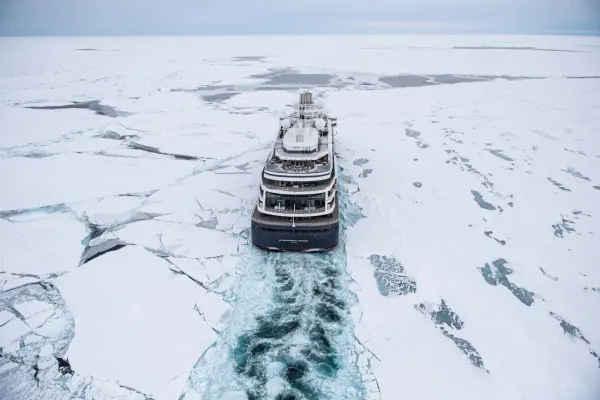
Let’s start with what makes this ship a ship rather than a floating hotel. The bow: 6 centimeters of steel. For comparison, the hull plating of a typical cruise liner is 1.5 to 2 centimeters thick. The sides: 4.5 centimeters. The frames — the structural ribs of the hull — are spaced every 40 centimeters. On an ordinary cruise ship, frames are spaced 2 meters apart. Five times further. Le Commandant Charcot is not simply a vessel with a reinforced hull. It is an armored fist sheathed in velvet.
Polar Class 2. Dry as a line from a technical specification. But behind that designation lies a capability that changes everything.
In the global classification of ice-going vessels, there are seven classes, from PC7 (capable of operating in thin first-year ice in summer) to PC1 (capable of operating in ice of any thickness year-round). PC1 means nuclear icebreakers — there are only a handful in the world, and every one of them is a working vessel without a single passenger seat. Le Commandant Charcot is PC2: able to break through multi-year ice up to 2.5 meters thick. Second out of seven. The highest class of any passenger vessel on the planet.
What does this mean in practice? It means the ship can go where ordinary cruise vessels would not dare appear on the horizon. Expedition yachts stop at the edge of pack ice and wait. Le Commandant Charcot enters the pack ice and drives through it, pushing floes aside with its bow like a knife through butter. The bays, the straits, the islands that Charcot spent months reaching under wooden sail — risking being frozen in for an entire winter — Le Commandant Charcot passes through in hours. Places where no one has ventured since Charcot himself, because no vessel could force a way through.
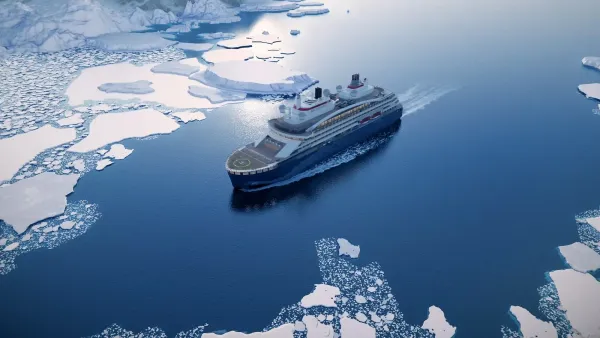
The propulsion system delivers 34 megawatts of power. To put that in context: a typical cruise liner produces around 5 megawatts. Le Commandant Charcot is seven times more powerful. Charcot’s Pourquoi Pas? had a steam engine rated at 450 horsepower — slightly more than a modern SUV. Le Commandant Charcot exceeds it by roughly 75 times.
But the most remarkable thing is not the power. It is the silence.
The hybrid propulsion system runs on liquefied natural gas and electricity. LNG is the cleanest of fossil fuels: half the CO₂ of heavy fuel oil, zero sulfur, zero soot. But Charcot, who lived in the age of coal furnaces, would have appreciated something else: the ship carries 5 megawatt-hours of battery capacity. It can shut down its engines entirely and cruise in silence on battery power alone. No vibration. No rumble. No exhaust.
Why? So as not to frighten the whales. Humpback whales in Antarctic waters communicate on low frequencies that carry for tens of kilometers. Engine noise drowns out their songs — literally depriving them of the ability to find a mate, warn of danger, or coordinate a hunt. Le Commandant Charcot in electric mode is invisible: it passes through a pod of whales without disturbing a single one.
Charcot, who in 1908 would stand for hours on the deck of the Pourquoi Pas?, listening to the silence of Antarctic bays — a silence broken only by the crackle of ice, the lap of water, and the distant exhalations of whales — would have valued this engineering detail more than all the megawatts of power combined. He knew how fragile silence could be. And how easily a single running engine destroys all the magic.

And now — the velvet.
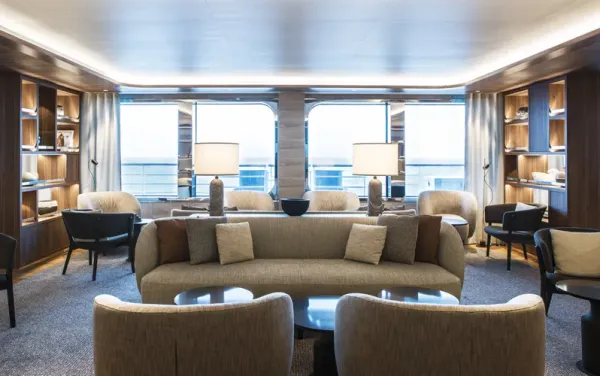
Inside, Le Commandant Charcot resembles no icebreaker in history. The interiors were designed by the studios of Jean-Philippe Nuel and Jean-Michel Wilmotte — architects who normally work with five-star hotels and private residences. Stone, wood, leather, subdued lighting. 123 cabins, among them 31 suites with panoramic balconies. Imagine standing on your balcony in a robe, facing a glacier wall the height of a nine-story building — blue as sapphire, veined with white and turquoise. Minus twenty degrees outside. Plus twenty-two in the cabin. Underfoot: warm natural-wood flooring. In your hand: a glass of Chablis. Behind you: a cabin designed by people who ordinarily work with the five-star hotels of Paris and Monaco.
Two restaurants with open kitchens, where the chef cooks from fresh provisions loaded aboard in Ushuaia — the last city before Antarctica. Breakfasts overlooking icebergs. Dinners with six-course tasting menus. An indoor pool surrounded by a winter garden with a glass ceiling — you swim in warm water while Antarctic clouds drift overhead. Beside it: a heated outdoor lagoon pool and an enormous hearth, where you can sit in the evenings wrapped in a blanket, watching the sun skim the horizon without ever setting.
A spa with sauna and hammam — to warm up after hours on a Zodiac among icebergs. A detox bar with herbal teas and smoothies. An open bar on the top deck — with the exception of premium spirits, everything is included. A panoramic lounge at the bow — armchairs, a library, a 180-degree view. Here people read, drink coffee, and watch in silence as the ship breaks through the ice.
Charcot on the Pourquoi Pas? was proud of his wine cellar and library — for 1908, unheard-of luxury on a research vessel. Le Commandant Charcot has carried that idea to a level unimaginable a century ago. But the philosophy is the same. Charcot understood: long expeditions demand not only courage but also comfort. A person who is frozen, hungry, and exhausted cannot be moved by the beauty of a glacier. They think only of food and warmth. The creators of Le Commandant Charcot learned that lesson.
And then there is the scientific dimension — the detail that transforms Le Commandant Charcot from a luxurious plaything into a true heir of the Pourquoi Pas?.
On board: 20 cabins reserved for scientists. Not passengers — scientists. Every expedition includes biologists, oceanographers, glaciologists, ornithologists — specialists from leading research institutions around the world. While passengers eat breakfast, the scientists are already on deck: collecting water samples, measuring temperature and salinity at various depths, logging the coordinates of whales spotted, counting birds. The data is transmitted to international scientific databases, including climate change monitoring programs.
Each evening, one of the scientists gives a lecture for passengers. Not a formal presentation with charts — a living account of what you witnessed that day. Why this glacier is blue and that one white. Why a whale leaps from the water. Why penguins build their nests from stones rather than snow. It is education through experience — you see a whale in the morning, and in the evening you learn that it traveled 8,000 kilometers to be here, at this very moment.
Charcot dreamed of this. A ship that would unite science and seamanship. Inquiry and wonder. Precise data and living feeling. The Pourquoi Pas? had three laboratories and thirty crew members. Le Commandant Charcot has twenty scientists, 215 crew, and equipment Charcot could not have imagined: hydroacoustic stations, satellite communications, drones for aerial surveys, underwater cameras.
The scale has changed. The spirit has not.
And on September 12, 2024, Le Commandant Charcot did something no ship in history had ever done.
It reached the Arctic Pole of Inaccessibility.
This is not the North Pole — the geographic point that icebreakers, submarines, and even ski expeditions have reached. The Pole of Inaccessibility is different. It is the point in the Arctic most remote from any land. One thousand kilometers to the nearest shore in any direction. Coordinates: 85°48’ North, 176°09’ East. The Russian explorer Alexander Kolchak — the future admiral himself — described this point in 1909, but its precise coordinates were only determined in 2013, using NASA satellites. Australian aviator Hubert Wilkins flew over it in 1927. But by sea — no one. Never.
Until Le Commandant Charcot.
The trans-Arctic passage followed a route that takes polar captains’ breath away: Nome, Alaska — Pole of Inaccessibility — Magnetic North Pole — Geographic North Pole — Longyearbyen, Svalbard. Three poles in a single voyage. No ship had ever accomplished anything of the kind. On board were 20 international scientists collecting data in zones where no measuring instrument had ever been placed.
Charcot perished aboard a wooden barque with a 450-horsepower steam engine. The ship bearing his name is breaking records that no one before had even attempted to set.
And in February 2027, that ship will go where Charcot spent the best years of his life. To Antarctica. Through the strait that sailors call the most fearsome ocean crossing on the planet.
Between this ship and Antarctica lies 800 kilometers of the stormiest ocean on Earth. A strait that has swallowed 800 ships and 20,000 sailors over five centuries. A strait discovered by a pirate — by accident.