136 meters. One breath. 3 minutes 41 seconds. That’s the height of a 40-story building — down and back up, on a single lungful of air.
In August 2023, at the CMAS World Championship, Alexey Molchanov descended to 136 meters on a monofin on a single breath. No tanks, no safety rope, no gas mixtures. Just lungs, body, and water.
This is the absolute world record in the CWT discipline — “constant weight.” The diver descends and ascends using only their own muscles. No assistance. No motor. A monofin — and nothing else.
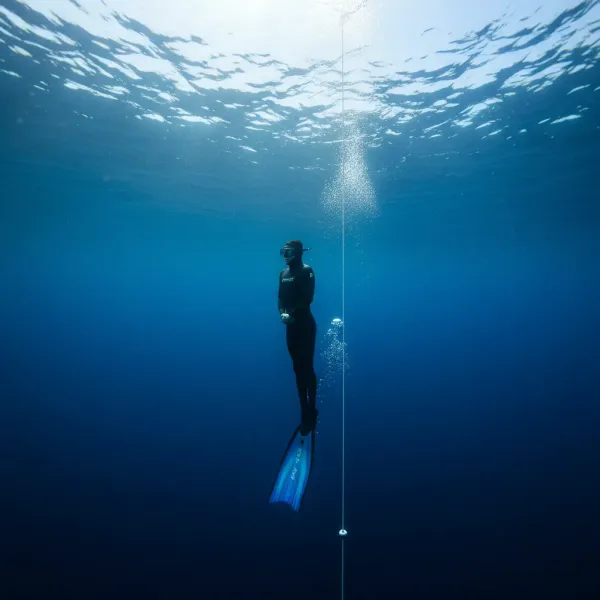
40+ world records. 22 World Championship gold medals. And a story that didn’t start with him.
Natalia
Alexey Molchanov was born in 1987 in Volgograd. His mother — Natalia Vadimovna Molchanova — was a competitive swimmer. At 40, she tried freediving. And changed the sport forever.
42 world records. 23 World Championship medals, 19 of them gold. The first woman to dive deeper than 100 meters on a single breath. The first to hold her breath for longer than 9 minutes. She swam through the Blue Hole in Dahab — a vertical underwater cave 135 meters deep — alone. Experienced scuba divers give this place a wide berth.
Natalia created a system of freediving instruction that is now used around the world. She opened a school. She trained hundreds of instructors. In effect, she built Russian freediving as a discipline.
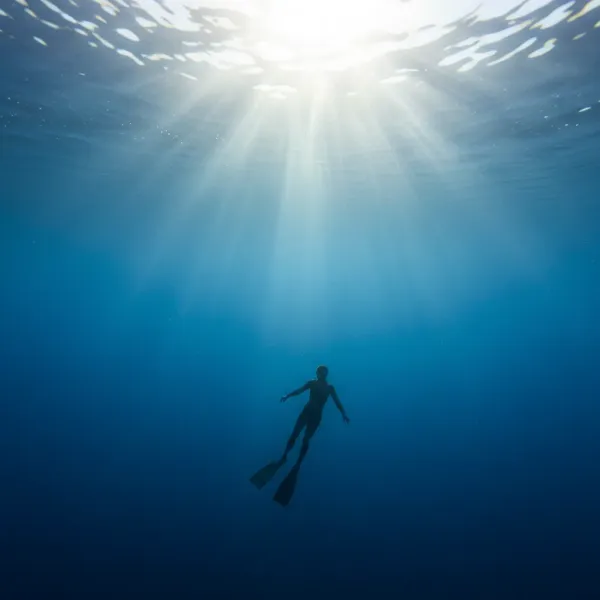
Alexey grew up near water. He started as a competitive swimmer, then moved to freediving — by which point his mother was already a world champion. He set his first world record in 2008: 250 meters in length in a pool on a single breath using a monofin.
His Own Path
In 2015, Natalia retired from competition. Alexey continued — and began setting records entirely his own.
2016 — 128 meters. 2018 — 130. 2021 — 131. 2023 — 136. Each new meter pushes the limits of human physiology.
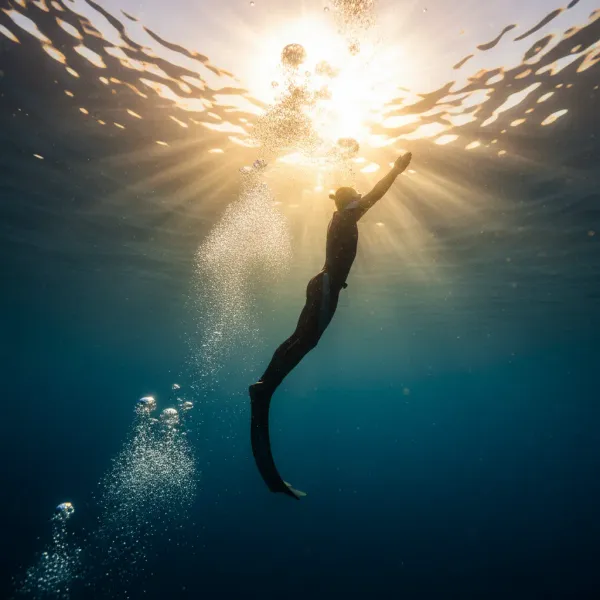
At 136 meters, the pressure is 14.6 atmospheres. The lungs are compressed to the size of a fist. The spleen pumps reserve red blood cells into the bloodstream — an ancient reflex shared with seals and whales. The heart rate slows to 20–30 beats per minute. Blood shifts away from the limbs toward the heart and brain. The body switches into a mode that is millions of years old.
The descent to 136 meters takes just over a minute. The ascent — about two and a half. The entire dive — 3 minutes 41 seconds. In that time, Alexey covers the height of a 40-story building — twice.
What It Looks Like
Freediving looks nothing like scuba diving. There are no bubbles, no sounds, no equipment beyond a fin and a wetsuit. Absolute silence.
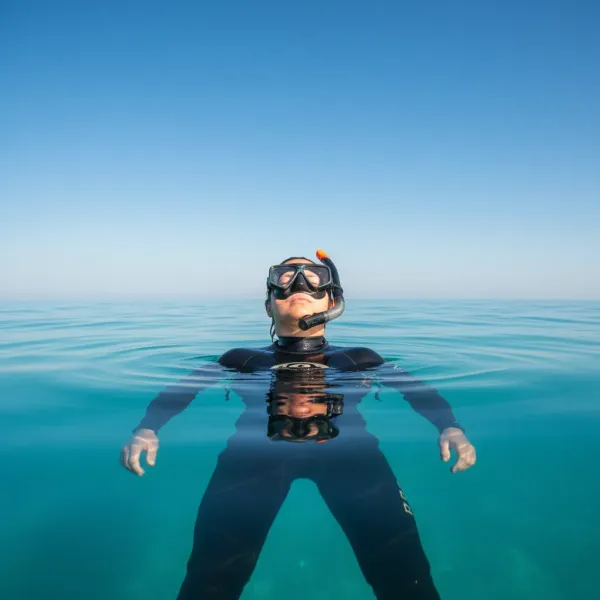
Before the dive, Molchanov lies on the surface, breathing through a snorkel. Several minutes of calm, deep breathing. Oxygen saturation. One final breath — and he rolls headfirst downward.
The first meters — active work with the fin. At 30–40 meters, “freefall” begins: the body becomes denser than water, and the diver simply sinks — effortlessly, motionlessly. He falls into the darkness, conserving every molecule of oxygen.
At the bottom — a touch of the plate. A turn. And the ascent — now fighting negative buoyancy, every kick of the fin counting.
The last 20 meters are the hardest. Oxygen is nearly gone. Muscles are spent. The diaphragm convulses — the body is demanding a breath. But there is nothing to breathe. The surface is 20 seconds away. Or an eternity.
Molchanovs
After Natalia’s death, Alexey founded Molchanovs — a freediving equipment brand and international training system. Molchanovs schools operate in dozens of countries. The teaching system Natalia began lives on.
Alexey dives, coaches, designs fins, and runs masterclasses. He lives between Moscow, Dahab, and competitions around the world.
When asked “why do you do this,” his answer never changes: “At depth, there is nothing unnecessary. Just you. It is the most honest place on earth.”
Give It a Try
Freediving is not an extreme sport for the obsessed. A basic course takes 2–3 days. Learning to hold your breath for 2–3 minutes and dive to 15–20 meters is within reach of almost any healthy person. It is not about records — it is about silence, control, and a feeling that cannot be found anywhere else.
And if you’d rather start with scuba — read Diving into the Unknown, about that first breath underwater.